The development of innovative optoelectronic devices (LEDs, detectors) relies on the knowledge of complex nanostructures. Understanding the coupling between internal mechanical strains and light-emitting properties is a major challenge for optimizing their performance. Conventional methods, such as electron microscopy, often have limitations, particularly due to the need to thin the sample, projection effects, and a restricted field of view. This study proposes a non-destructive multimodal approach using synchrotron X-rays to probe these properties at the very heart of the material.
Researchers at
CEA-Irig/MEM/NRX used a sub-micrometer X-ray probe (300×300 nm²) at the French BM32 beamline at the ESRF to simultaneously analyze the structure and the light emitted by InGaN/GaN core-shell micro-wires. Using
Laue micro-diffraction* and X-ray-induced luminescence (XEOL), they independently measured the internal strains in the core and shell with excellent precision by performing a complete mapping of the
deviatoric tensor*. An automated analysis, capable of processing tens of thousands of X-ray diffraction images and luminescence spectra, revealed an indium composition gradient in the
quantum wells* (from 10% at the top to 8% at the bottom), which shifts the emitted color from blue towards the UV. These measurements, confirmed by numerical simulations, allow for a direct link between the wire's morphology and its luminescent performance.
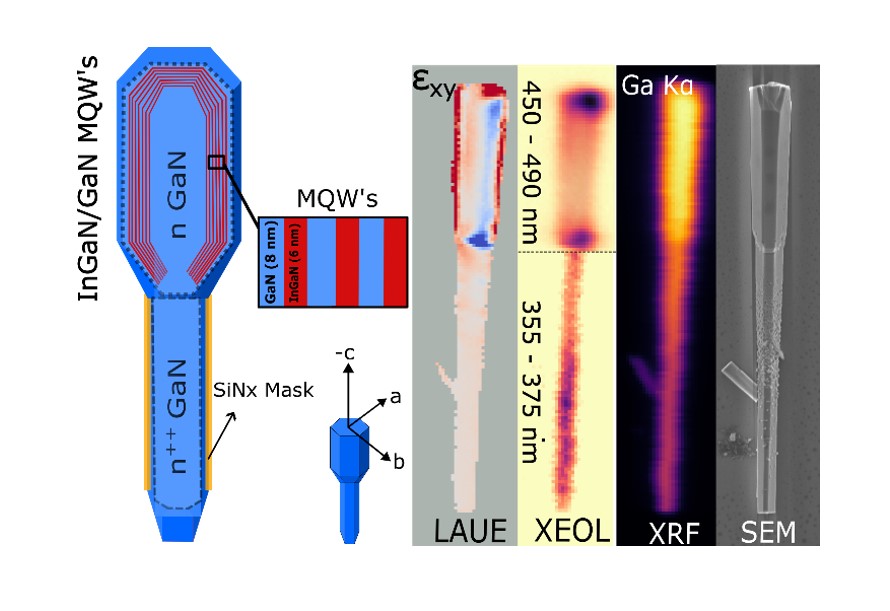
© CEA-Irig/MEM/NRX
Figure : Schematic of GaN microwires with multiple InₓGa₁₋ₓN/GaN core-shell quantum wells located at the top of the structure. Maps obtained by micro-Laue diffraction (strain component εxy), XEOL—windows 450–490 nm and 355–375 nm—X-ray fluorescence (Ga Kα), and SEM.
This internationally unique experimental development, conducted on the French BM32 beamline at the ESRF (Grenoble) using the new LaueMax instrument, enables non-destructive structural and optical characterization of nanostructures compatible with high-throughput analysis. This innovative approach paves the way for the optimized design of future ultra-efficient optoelectronic devices.
nitride heterostructures*: a stack of several semiconductor materials based on gallium nitride (GaN), aluminum nitride (AlN), and indium nitride (InN). The design of the interfaces enables new properties such as the confinement of electrons in one dimension (formation of quantum wells), the creation of two-dimensional electron gases, or even better control of current and light.
luminescence*: the emission of light following non-thermal excitation. In XEOL, excitation occurs via X-rays; in cathodoluminescence, via electrons; and in photoluminescence, via photons.
InGaN/GaN microwires*: micrometer-scale wire-shaped structures consisting of stacked layers of indium gallium nitride and gallium nitride, which emit, detect, or modulate light. They can have core-shell or longitudinal geometries.
Laue micro-diffraction*: X-ray diffraction technique using a focused polychromatic beam to locally analyze the orientation and deformations of a crystal at the micrometer scale.
deviatoric tensor*: used to describe the shear strains in a material’s atomic lattice.
quantum wells*: layer of semiconductor material (e.g., InGaN) sandwiched between two layers of “barrier” semiconductor material (e.g., GaN), confining electrons in one dimension and causing their energy levels to become quantized. One of the main consequences is a change in optical properties (LED efficiency, color of the emitted light, etc.).
Tutelles UMR : MEM/NRX : CEA, Univ. Grenoble Alpes (UGA); PheliQS/NPSC : CEA, UGA, Grenoble INP - UGA.
Fundings : Agence Nationale de la Recherche (Project MAGNIFIX), France 2030 (PEPR-DIADEM-ESRF), PTC CEA Lumix.
Collaborations : CNRS (Institut Néel), European Synchrotron Radiation Facility (ESRF, Grenoble). Ligne française F-CRG IF BM32 (CEA, CNRS).