 The Laue Langevin Institute (ILL) high-flux reactor and the European synchrotron radiation source (ESRF).
Credit: ESRF/P. Ginter
The MDN laboratory was created by L. Néel and E.F. Bertaut in the early sixties in order to study condensed matter physics by means of neutron scattering techniques.
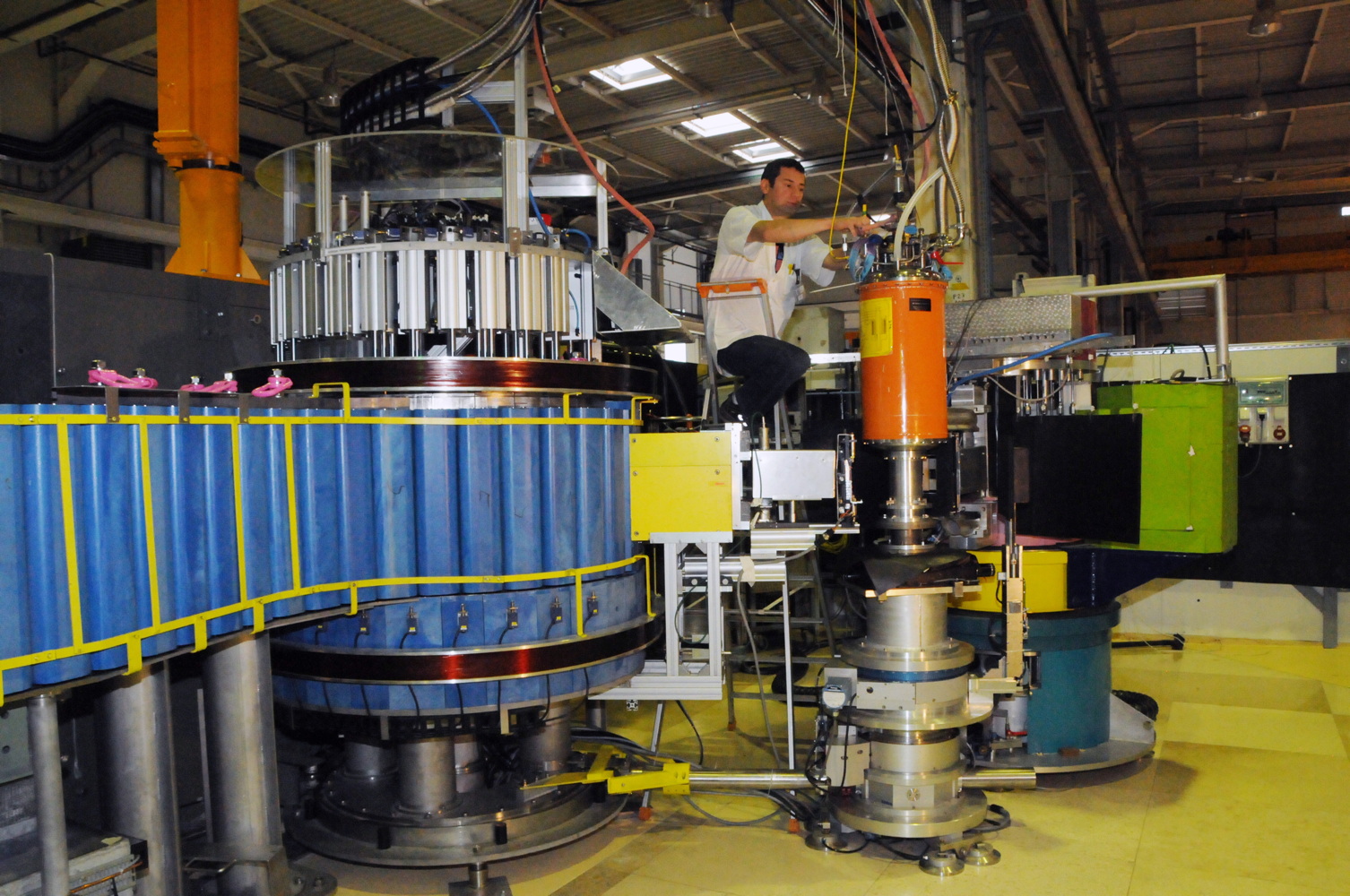
Since 1995, its activity is based on the operation of three CRG intruments (IN12, IN22 and D23) installed at Institut Laue Langevin.
The laboratory is specialized in:
• Fundamental study of magnetism
• The developpment of high-performance neutron instrumentation.
•
Basic magnetism:

- quantum spin systems
- magnetic frustration
- magnetism and superconductivity
• Functional materials:
- multiferroic materials
- magnetocaloric materials
- thermoelectric materials
- Experimental techniques and facilities
MDN laboratory operates four CRG instruments located at
Institut Laue Langevin:
• The cold neutron three-axis spectrometer
IN12 in collaboration with FZJ, Germany.
• The thermal neutron three-axis spectrometer
IN22.
• The thermal neutron two-axis diffractometer for single crystals
D23.
The laboratory has an important activity in neutron instrumentation:
• Spectrometers: conception and installation of instruments, neutron optics and instrument control.
• Sample environment: low temperatures, high magnetic field and high pressure.
• Polarized neutrons: spherical polarimetry, helium 3 spin filter, neutron spin-echo.
 | |
| |
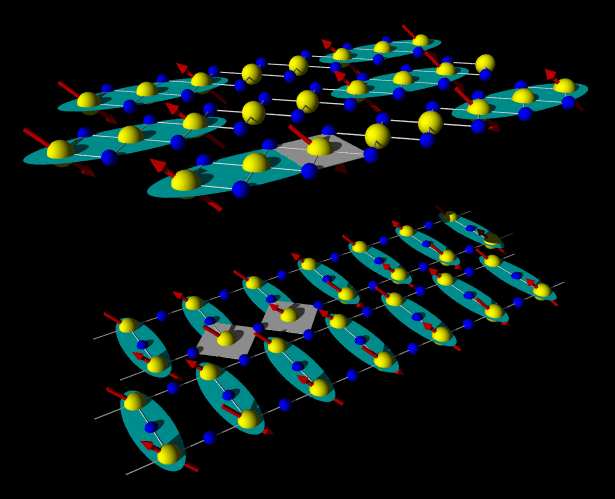
The chain and ladder system Sr14Cu24O41 | |
- CNRS (Grenoble, Orsay, Nancy)
- Université Grenoble Alpes (Grenoble)
- Laboratoire Léon Brillouin (Saclay)
- Institut Laue Langevin (Grenoble)
- Brookhaven National Laboratory (USA)
- Oak Ridge National Laboratory (USA)
- Groupe de diffusion neutronique de Gatchina (St Petersbourg, Russie)
- Tokyo Metropolitan University (Japon)
- Kyushu University, Fukuoka (Japon)